 取得
取得


監製:Flora Yeung

This episode follows Lin Zexu’s cast of mind as the first “to open his eyes to the world,” and the long resonance that crossed borders. It begins with his work compiling and translating the Gazeta de Macau e Timor, and follows the thread to Wei Yuan’s Illustrated Treatise on the Maritime Kingdoms, shaped by Lin’s efforts and later carried to Japan, where it helped inspire the Meiji Restoration. The story then moves through the careers of Zuo Zongtang, Shen Baozhen, and Yan Fu, linking the self-strengthening movement to the creation of a modern navy.
It closes in the present with Hong Kong’s return and the carrier Shandong’s visit, answering the century-long quest for strength embodied by Lin Zexu, and affirming the great passage of the Chinese nation, from travail to renewal, from endurance to resurgence.

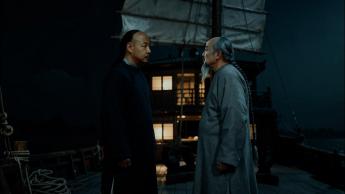
This episode follows Lin Zexu’s cast of mind as the first “to open his eyes to the world,” and the long resonance that crossed borders. It begins with his work compiling and translating the Gazeta de Macau e Timor, and follows the thread to Wei Yuan’s Illustrated Treatise on the Maritime Kingdoms, shaped by Lin’s efforts and later carried to Japan, where it helped inspire the Meiji Restoration. The story then moves through the careers of Zuo Zongtang, Shen Baozhen, and Yan Fu, linking the self-strengthening movement to the creation of a modern navy.
It closes in the present with Hong Kong’s return and the carrier Shandong’s visit, answering the century-long quest for strength embodied by Lin Zexu, and affirming the great passage of the Chinese nation, from travail to renewal, from endurance to resurgence.

This episode journeys deep into Ili, Xinjiang, tracing the marks Lin Zexu left in his years of exile. Through the voices of historians and water engineers, it recounts how he threw himself into the building of a vital waterway—later honoured as the “Lin Gong Canal”—and took part in the demanding survey of 600,000 mu of land.
The route also leads to qanat villages that still draw on ancient methods and to the rice fields of Aksu, looking back on Lin’s efforts to spread agricultural techniques and, through steady work, improve lives on the frontier. The camera moves between modern hydraulic projects and historical sites, bearing out his foresight in “strengthening Xinjiang and securing the border”, and the deep bond he forged with the people.
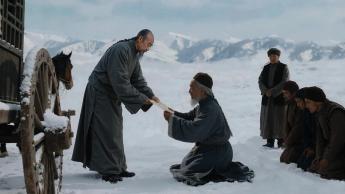
This episode traces Lin Zexu’s road into exile in Xinjiang, setting out from Xi’an, passing through mighty Jiayuguan and the austere Xingxing Gorge, and on into the Tianshan. His parting vow—“I shall dedicate myself to the interests of the country in life and death”—is set against the ache of departure, while the Gobi’s snow and wind make plain the loneliness and grind of the long march.
Visits to the Hami Hui King’s city and the Liaodun beacon towers draw out his work in Xinjiang: redressing wrongful cases and offering sound counsel. Through scholars’ eyes, the film shows how a former guardian of the coasts turned to the security of the frontier, warned of Russian designs along the border, and, amid adversity, kept faith with the people and the realm, showing the breadth of his concern.
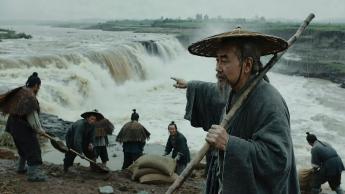
This episode turns to a lesser-told legacy: Lin Zexu’s mastery of water. In 1841, the Yellow River burst its banks. Exiled and en route, Lin was urgently summoned to Kaifeng to lead the response. In Zhangwan Village, Henan, the “Lin Gong Dyke” still stands as a silent witness. Through villagers’ memories and historians’ insights, the episode returns to that moment and shows how a man condemned as a “disgraced official” led the fight against the flood.
From there, the story moves to Fuzhou, his birthplace. His descendants recall two “heirlooms” and the family maxims known as the “Ten Things That Do No Good,” offering a window onto the frugal household codes that shaped his probity and sense of duty.
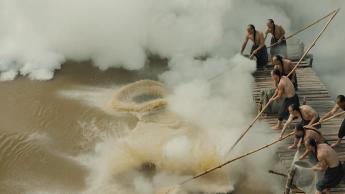
The trail opens on Pottinger Street in Central, Hong Kong, with a buried keystone in view: a letter Lin Zexu addressed to Britain’s queen, a prelude to events that would shape the city’s fate. The host walks the sites of the first clashes with Britain and recalls Lin’s resolve to fortify the coast with shore batteries to defend the island.
With historians’ close analysis, the episode reconstitutes the tempests off Humen and weighs the contest between China and Britain in its time. The camera glides between Hong Kong’s contemporary cityscape and its quieter historical marks, tracing Lin’s steady concern for this coast and uncovering the imprints history has left on the city.