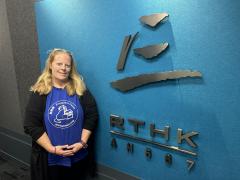
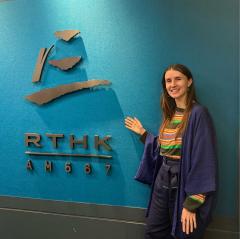
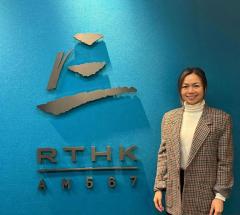
Listen to #Hashtag Hong Kong every Sunday morning at 8.15
Focusing on issues affecting civil society, we'll hear from representatives of NGOs, associations, statutory bodies, and non-profit groups.
(Sundays 8.15am - 8.25am)


Good morning everyone!
Hong Kong is home to over 340,000 migrant domestic workers. They are the backbone of our households, caring for our children, supporting our elderly, and keeping our homes running smoothly. Yet, many face financial pressures, recruitment debt, and even fraud.
Enrich exists to change that story. I think of Eka, a migrant domestic worker from Indonesia who has lived in Hong Kong for more than 20 years. When she first arrived, she faced enormous financial pressures and struggled to manage her income. Like many women, she carried the weight of supporting her family back home while navigating life in a new city.
Eka joined Enrich’s financial and empowerment workshops, and she describes the experience as life changing. She learned how to budget, save, and plan for the future. Over time, she built the confidence to take control of her finances and even began to dream of starting her own business.
What inspires me most is her determination. Eka told me that before Enrich, she didn’t know how to manage money. Now she feels confident and knows that she can build a better future for herself and her family.
Her journey reminds us that true empowerment goes beyond statistics—it's rooted in dignity, hope, and rekindling the capacity to dream. Eka’s story reflects the resilience of so many migrant domestic workers in Hong Kong, and why Enrich’s mission matters.
Through financial and empowerment education, we help women learn to budget, save, and plan for their futures. We also provide workshops on communication, well being, and entrepreneurship. Since 2007, tens of thousands of women have joined our programmes, and many have told us how these tools gave them hope, confidence, and control over their lives.
People often ask me why I chose to lead Enrich. The answer is simple: because empowerment is transformative. When a woman learns to take charge of her finances, she doesn’t just change her own life; she changes the lives of her children, her family, and her community back home. Education is the most sustainable form of support we can offer, and I am proud to be part of an organisation that invests in women who, in turn, invest in the world.
At Enrich, we were deeply saddened by the devastating fire at Wang Fuk Court. Our hearts go out to all those affected, especially the migrant domestic workers who lost their homes and belongings, and the families that lost their sisters, daughters, and mothers. In the days that followed, we witnessed the generosity of the Hong Kong community, but we also saw opportunists trying to exploit the tragedy. That is why we dedicated our Giving Tuesday donations directly to those impacted, with a special focus on migrant domestic workers.
This March, we will celebrate International Women’s Day with one of our biggest events of the year: “Empowering MDWs: Resilience, Wellbeing & Pathways Forward.”
Today, we celebrate the resilience of migrant domestic workers and support those affected by the tragic Tai Po fire. Together with our co host, the Social Innovation Team at the Knowledge Transfer Office of the Chinese University, we will welcome migrant domestic workers and the wider community to InnoPort in Sha Tin. We chose this venue to reach more workers living and working in and around Tai Po.
The event will feature:
- Booths offering practical support, from mental health counselling and women’s health resources to financial consultation, legal aid, and upskilling opportunities.
- Interactive sessions covering financial literacy, fraud prevention, safety awareness, women’s wellbeing, and entrepreneurship.
- Wellness and art activities, such as Piloxing, artwork creation, and breathing exercises, to refresh and inspire participants.
- Booths showcasing migrant domestic worker groups and NGOs with business ideas and skill demonstrations.
This event is about more than services. It is about community, empowerment, solidarity, and pathways forward for migrant domestic workers in Hong Kong.
Reflecting on my journey with Enrich, I realize that empowerment starts with listening—listening to voices that are often overlooked and recognising their strength, resilience, and dreams. Hong Kong is a city of opportunity. Let us ensure that opportunity is shared. Let us invest in the women who invest in us every day.
I invite you to join us on International Women’s Day to stand with migrant domestic workers, celebrate their resilience, and help build a future where every woman has the tools to reach her goals.
Thank you for listening, and I hope you can support Enrich HK in some ways. Together, we are making a meaningful difference.

Hello! Its great to be here with you! We’re diving into Hong Kong’s clothing waste today - local challenges and opportunities, the subject of a new report just released by our team at Redress, a Hong Kong-based, Asia-focused environmental NGO on a mission to accelerate the transition to a circular fashion industry. We do this by educating and empowering designers and consumers in order to reduce clothing’s negative environmental impacts.
Redress’ programmes primarily target fashion designers and consumers. We also work with brands, manufacturers, research institutions, schools, and corporations to create better ways to design, produce, purchase, use, and recycle clothing. We’ve just wrapped up their annual Get Redressed Month, Hong Kong’s largest consumer awareness campaign about circular fashion. Organised by Redress, this annual month-long campaign gathers 100+ corporates, clubs, organisations, schools, and the general public to raise awareness about the environmental impact of our clothing choices and shift attitudes and habits towards reducing clothing waste.
Textile waste is widely recognised as a growing global issue. Locally in Hong Kong, an average daily quantity of 402 tonnes of textiles were landfilled in 2023, of which a substantial portion is thought to be clothing. This is the equivalent of 17,480 suitcases of textiles landfilled every single day! While there are many solutions in development globally, in Hong Kong progress is slow. Redress’ report, which we’ll be looking at today, highlights the challenges and opportunities, and calls for action for material recovery solutions for non-wearable clothing waste to build stronger leadership and example in our region.
The lack of specific data about the nature of the textile and clothing going to landfill - this is such as composition mix, colour and condition - is the first hurdle to be overcome. This type of data will enable the Hong Kong fashion and textile industry to understand what solutions need to be developed to address today’s clothing waste issue. Redress, one of Hong Kong’s charities operating a Takeback Programme, made a pilot study to get insights on the non-wearable clothes that they received. Results show that there is a big opportunity in recovering textiles to a higher value than what is done today: between 15% and 37% of non-wearable clothes could have potential for reconstruction or fibre-to-fibre recycling.
Hong Kong’s clothing waste issue is the consequence of a few different types of challenges. Redress gathered local industry stakeholders to dig into these issues and identified three major challenges: lack of sorting and recycling infrastructure, lack of perceived business value, and lack of consumer education.
There is no silver bullet solution to tackle Hong Kong’s clothing waste, but many untapped opportunities have been identified. These include advancements in sorting technologies to
improve material recovery, developing remanufacturing initiatives that can transform discarded clothing into new products and building stronger, actionable stakeholder education on circular fashion practices, such as showcasing textile art to raise awareness about Hong Kong’s fashion consumption. By implementing these strategies, the industry can significantly reduce and divert textile waste from landfills and recover materials for higher-value applications.
As for consumers, we can care for and love our clothing for longer to prolong their lifespan in order to reduce the need to replace items, making sure that when we do, we opt for more sustainable brands and second-hand clothing. Plus, we can participate in local clothing drives and educational workshops to promote sustainable practices, while keeping up to date with the latest advancements in sustainability and circularity.
Finally, Redress outlines specific actions that all stakeholders—including brands, designers,
manufacturers, and policymakers—can take to facilitate this transition to a circular fashion economy. Key recommendations include building a strong ecosystem to promote collaboration on circularity across the industry, increasing designer education on ‘eco-design’ or ‘sustainable design’, and advocating for supportive government policies that incentivise circularity.
Circularity relies on collaborative action, which is why Redress recommends cross-sector partnerships, a coalition, to be formed in Hong Kong by fashion and textiles stakeholders
to connect needs and resources, just as there exist many fashion coalitions around the world, all with different focuses.
By fostering commitment to these initiatives, Hong Kong can position itself as a leader in circular fashion, addressing the current local textile waste while promoting long-term environmental and economic benefits for the local textile industry.