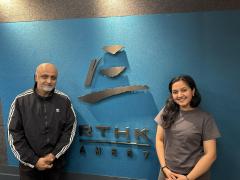
Listen to #Hashtag Hong Kong every Sunday morning at 8.15
Focusing on issues affecting civil society, we'll hear from representatives of NGOs, associations, statutory bodies, and non-profit groups.
(Sundays 8.15am - 8.25am)

Good morning everyone!
Hong Kong is home to over 340,000 migrant domestic workers. They are the backbone of our households, caring for our children, supporting our elderly, and keeping our homes running smoothly. Yet, many face financial pressures, recruitment debt, and even fraud.
Enrich exists to change that story. I think of Eka, a migrant domestic worker from Indonesia who has lived in Hong Kong for more than 20 years. When she first arrived, she faced enormous financial pressures and struggled to manage her income. Like many women, she carried the weight of supporting her family back home while navigating life in a new city.
Eka joined Enrich’s financial and empowerment workshops, and she describes the experience as life changing. She learned how to budget, save, and plan for the future. Over time, she built the confidence to take control of her finances and even began to dream of starting her own business.
What inspires me most is her determination. Eka told me that before Enrich, she didn’t know how to manage money. Now she feels confident and knows that she can build a better future for herself and her family.
Her journey reminds us that true empowerment goes beyond statistics—it's rooted in dignity, hope, and rekindling the capacity to dream. Eka’s story reflects the resilience of so many migrant domestic workers in Hong Kong, and why Enrich’s mission matters.
Through financial and empowerment education, we help women learn to budget, save, and plan for their futures. We also provide workshops on communication, well being, and entrepreneurship. Since 2007, tens of thousands of women have joined our programmes, and many have told us how these tools gave them hope, confidence, and control over their lives.
People often ask me why I chose to lead Enrich. The answer is simple: because empowerment is transformative. When a woman learns to take charge of her finances, she doesn’t just change her own life; she changes the lives of her children, her family, and her community back home. Education is the most sustainable form of support we can offer, and I am proud to be part of an organisation that invests in women who, in turn, invest in the world.
At Enrich, we were deeply saddened by the devastating fire at Wang Fuk Court. Our hearts go out to all those affected, especially the migrant domestic workers who lost their homes and belongings, and the families that lost their sisters, daughters, and mothers. In the days that followed, we witnessed the generosity of the Hong Kong community, but we also saw opportunists trying to exploit the tragedy. That is why we dedicated our Giving Tuesday donations directly to those impacted, with a special focus on migrant domestic workers.
This March, we will celebrate International Women’s Day with one of our biggest events of the year: “Empowering MDWs: Resilience, Wellbeing & Pathways Forward.”
Today, we celebrate the resilience of migrant domestic workers and support those affected by the tragic Tai Po fire. Together with our co host, the Social Innovation Team at the Knowledge Transfer Office of the Chinese University, we will welcome migrant domestic workers and the wider community to InnoPort in Sha Tin. We chose this venue to reach more workers living and working in and around Tai Po.
The event will feature:
- Booths offering practical support, from mental health counselling and women’s health resources to financial consultation, legal aid, and upskilling opportunities.
- Interactive sessions covering financial literacy, fraud prevention, safety awareness, women’s wellbeing, and entrepreneurship.
- Wellness and art activities, such as Piloxing, artwork creation, and breathing exercises, to refresh and inspire participants.
- Booths showcasing migrant domestic worker groups and NGOs with business ideas and skill demonstrations.
This event is about more than services. It is about community, empowerment, solidarity, and pathways forward for migrant domestic workers in Hong Kong.
Reflecting on my journey with Enrich, I realize that empowerment starts with listening—listening to voices that are often overlooked and recognising their strength, resilience, and dreams. Hong Kong is a city of opportunity. Let us ensure that opportunity is shared. Let us invest in the women who invest in us every day.
I invite you to join us on International Women’s Day to stand with migrant domestic workers, celebrate their resilience, and help build a future where every woman has the tools to reach her goals.
Thank you for listening, and I hope you can support Enrich HK in some ways. Together, we are making a meaningful difference.

Good morning. I am here to talk about a mission of freedom, companionship, and how we are addressing two of Hong Kong's most pressing social needs through the incredible power of trained dogs.
Established in 2012, our foundation was built on a clear and critical goal: to provide professionally trained guide dogs to our visually impaired community, thereby offering them the life-changing gifts of mobility, independence, and dignity. Our vision has always been a Hong Kong where every visually impaired person who needs one can have the freedom a guide dog provides.
In our city, there are approximately 160,000 visually impaired individuals. Now, consider this number: we currently have only about forty guide dogs in active service.
The International Guide Dog Federations suggests one guide dog for every hundred visually impaired individuals. Here, we are serving far less than one percent of the need. Every successful guide dog pairing is a triumph, but it also highlights the immense gap we are striving to fill. Each person on our waiting list is someone whose world is smaller than it should be, waiting for the key that a guide dog represents.
This urgent need is the core of our work. But it’s not our entire story. In the course of our rigorous training program, we encountered a beautiful phenomenon. Not every dog has the specific temperament to be a guide dog. Some, while wonderfully intelligent and affectionate, are better suited for a different kind of service. We call them “career-change” dogs. Instead of seeing this as a conclusion, we saw it as a new beginning. We asked: what other profound impacts to our society can these exceptional dogs achieve?
This inquiry led us to innovate, creating our Animal-Assisted Services and our pioneering Companion Dog Programme. We are proud to have launched Hong Kong's first resident companion dog service for elderly homes, and the first such service in collaboration with the Correctional Services Department.
The need we are addressing is profound. We all believe our elders deserve a life of health, wellness, and dignity. Yet, recent study indicates a great social pain point: one in every ten elderly persons in Hong Kong experiences emotional issues such as anxiety and depression. Loneliness and isolation are very real challenges.
Our response was to deploy our carefully selected companion dogs into these environments. But we didn't want to rely just on heartwarming stories; we wanted evidence. So, we partnered with Shue Yan University to conduct a formal, six-month study at two elderly homes. The results were unequivocal.
At the beginning of the programme, 38 percent of the elderly residents showed different levels of depression and anxiety. After six months with our resident companion dogs, that figure saw a dramatic and significant drop—down to just 17 percent.
This is a demonstrable outcome. It represents a tangible improvement in the quality of life for our elderly. It is solid evidence that we have powerful, effective, and non-pharmaceutical means to alleviate emotional distress. This proven methodology is not limited to elderly homes; it is a model we are now applying to support students with emotional problem, and to provide comfort to end-of-life patients in hospices.
So, you see, our work creates two powerful streams of impact. One stream provides the gift of independence, trust and safety to the visually impaired. The other provides the gift of emotional support and connection to the isolated and vulnerable.
A mission of this scope and complexity cannot be achieved alone. We rely on the heart and support of our community. That is why I am here today, to ask for your help.
I invite you to come and see us at our first Hong Kong guide dog training school. We offer guided tours of our training school. Witness the dedication of our trainers, the intelligence of our dogs, and the tangible reality of our mission. Let us show you what your support makes possible.
Please consider becoming a volunteer. Whether it's helping to socialise our puppies or assisting with our daily operations, your time and energy are invaluable gifts that directly fuel our work.
We are not just training dogs. We are building a more inclusive, compassionate, and supportive Hong Kong. We are unlocking potential and easing pain. With your help, we can ensure that everyone who needs a guide to navigate the world, or a companion to warm their heart, will have one.
Thank you for your time, and for your belief in a kinder future.
To end this programme ,I would like to play "You'll Never Walk Alone" by Josh Groban. We hope that by empowering the visually impaired with guide dogs as a team, one would never walk alone. I hope you enjoy.